
Find the exact moment Jupiter returns to your natal degree
This Jupiter return calculator finds when transiting Jupiter reaches the same ecliptic longitude it held at your birth. It is a calculated planetary contact, rather than a general period when Jupiter happens to move through the same zodiac sign.
Jupiter completes this cycle roughly every 11.86 years, which is why returns are often associated with ages 12, 24, 36, 48, and beyond. The real timing varies from person to person. Jupiter’s apparent motion changes over time, and a return can fall months before or after a birthday. An exact calculation uses your natal Jupiter degree and searches for the moment Jupiter reaches that same degree again.
This Jupiter return calculator works from your birth date, birth time, and birth place to establish your natal chart. It then calculates Jupiter’s natal longitude and finds the selected future return. The result gives you the exact date and time in the relevant timezone, your age at the return, and whether Jupiter is moving direct or retrograde at that moment.
Choose the return cycle you want to examine
The calculator offers the first seven Jupiter returns. These age ranges are useful orientation points, not fixed deadlines:
| Jupiter return | Approximate age range |
|---|---|
| 1st Jupiter return | 11–13 |
| 2nd Jupiter return | 23–25 |
| 3rd Jupiter return | 35–37 |
| 4th Jupiter return | 47–49 |
| 5th Jupiter return | 59–61 |
| 6th Jupiter return | 71–73 |
| 7th Jupiter return | 83–85 |
A 2nd Jupiter return often falls around age 24, while a 3rd Jupiter return commonly arrives around age 36. Those broad ages come from Jupiter’s approximately 12-year cycle. Your own exact return depends on the degree of Jupiter in your natal chart and Jupiter’s movement during that cycle.
Selecting a return number tells the calculator which cycle to locate. If you are approaching a milestone age, choose that corresponding return. If you are reviewing an earlier chapter of life, you can calculate a past return and compare its chart with what was happening at the time.
Why exact timing can differ from a simple 12-year estimate
Adding 12 calendar years to a birth date gives only a rough guess. Jupiter does not move at a perfectly constant rate from Earth’s perspective, and it periodically appears to move retrograde. The calculation therefore starts with an approximate cycle anchor, then searches around it for the precise longitude match.
The tool converts your birth details into a UTC timestamp, calculates Jupiter’s natal position from ephemeris data, and searches for a later point when transiting Jupiter reaches that same longitude. It refines the result to identify the exact crossing time rather than treating a sign change or birthday year as the return itself.
A return is about degree, not sign alone. For example, natal Jupiter at 18° Leo has its return when Jupiter reaches 18° Leo again. Jupiter entering Leo is relevant background, but it is not yet the exact return unless it reaches the natal degree.
This distinction can matter when you are trying to place the return alongside a move, course of study, professional decision, relationship shift, or other life chapter. The date is calculated astronomy. Any personal meaning you draw from that timing belongs to astrology’s interpretive tradition.
What the calculator uses from your birth details
Your birth date, time, and place establish the natal moment used to calculate Jupiter’s original longitude. Accurate birth data improves the precision of the return date and supports the rest of the chart comparison.
Your birth time is especially useful because it fixes the natal timestamp and allows the calculator to generate chart angles and houses. If your recorded time is uncertain, Jupiter’s calculated natal longitude may still be close enough for a useful starting point, but house placements and angles become less reliable. A difference of minutes can sometimes matter near a house cusp or angle.
Your birth place supplies the coordinates and timezone context needed to convert local birth information into the correct universal time. It also establishes the default location for the return chart.
The form also includes a house system. Placidus is selected by default. House systems divide the chart into twelve areas from the local horizon and meridian, so they affect house cusps, the Ascendant, the Midheaven, and the house placement of planets in the return chart. They do not change the underlying moment when Jupiter reaches its natal longitude.
Return location and what it changes
By default, the return chart is calculated for your birth location. You can choose a different location if you expect to be elsewhere or want to examine the chart from another place.
The exact Jupiter return is based on Jupiter’s geocentric ecliptic longitude matching your natal Jupiter longitude. Changing location does not create a different planetary return moment. It does affect the local timezone shown for the event and the chart’s angles, houses, and house cusps.
That makes return location a chart-context choice. Someone comparing a return at their birthplace with a return at their current home may see a different Ascendant or different house placements, even though the planetary return occurs at the same instant.
Use the place where you want the return chart’s local framework to be set. If you have no particular reason to choose another location, the birth-location default keeps the calculation straightforward.
Direct and retrograde Jupiter return passes
Jupiter can appear to reverse direction in the sky during a retrograde period. When this happens near your natal Jupiter degree, it can make more than one exact contact during the same return cycle.
A sequence may include:
- a direct pass as Jupiter first reaches the natal degree
- a retrograde pass as Jupiter moves back across that degree
- a later direct pass after Jupiter turns forward again
The calculator searches for exact crossings around the selected return cycle. When several passes are present, it selects the first direct-motion pass by default. If no direct pass is found, it uses the first available exact pass.
The result identifies Jupiter’s motion at the selected return as direct or retrograde. This is a calculated property of the planet’s apparent motion at that time. In astrology, some readers treat a retrograde pass as a prompt to revisit an existing theme, while a direct pass may be read as more outwardly expressed. Those are interpretive approaches, not measurements of what will happen.
A multi-pass return can be useful for reflection because it places the same natal degree in focus more than once. You might use the dates as journal markers: what began around the first contact, what was reconsidered during a retrograde phase, and what felt clearer after Jupiter moved direct again. The dates themselves do not require a particular event to occur.
Reading the chart comparison
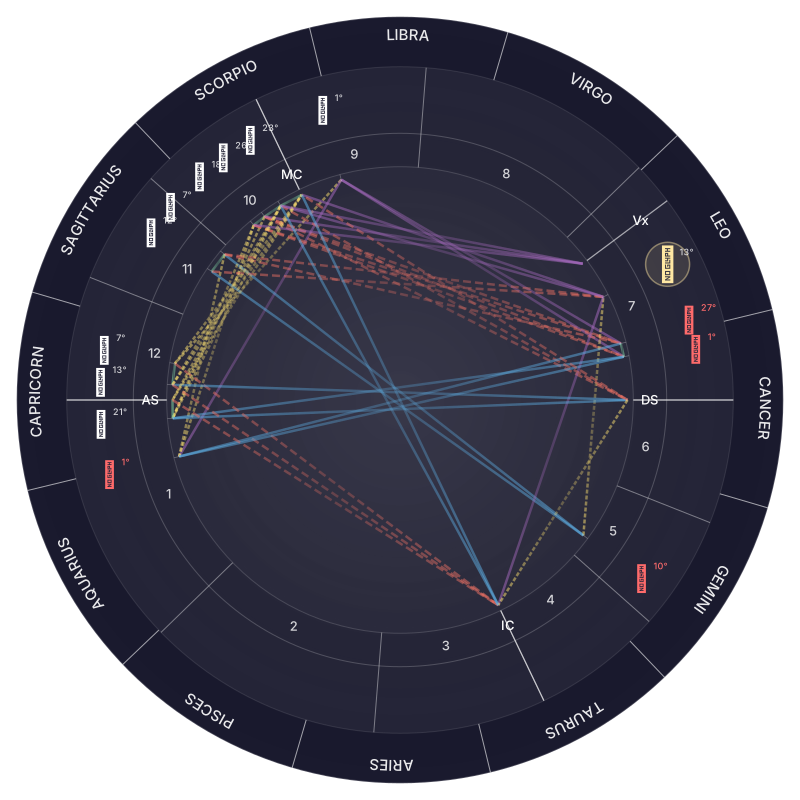
After calculation, the page places your natal chart alongside the Jupiter return chart. The natal chart is the baseline: it shows the planetary positions and houses for your birth moment. The return chart shows the sky at the exact selected return moment, using your chosen return location and house system.
The visual comparison uses the natal chart as the inner ring and the Jupiter return chart as the outer ring. This lets you inspect how the return-time planets relate to natal placements. The results also provide natal and return planet positions, house information, aspects, and chart patterns.
Start with the plainly calculated details:
- Exact date and time: the selected moment Jupiter reaches your natal longitude.
- Natal Jupiter longitude: the degree Jupiter occupied at birth.
- Return Jupiter position: Jupiter at that same degree at the return.
- Jupiter motion: direct or retrograde at the selected pass.
- Return-chart houses and angles: calculated from the selected location, time, and house system.
- Aspects: angular relationships between chart points, shown from calculated positions.
Then decide which pieces are most relevant to the question you brought to the chart. A return chart can contain a lot of information. You do not need to make every placement carry equal weight.
Jupiter’s traditional themes in astrology
In Western tropical astrology, Jupiter is traditionally associated with growth, learning, perspective, faith, opportunity, travel, teaching, publishing, mentors, generosity, and the search for meaning. It is also associated with excess, overreach, inflated expectations, and taking on more than is realistic.
A Jupiter return is often interpreted as the beginning of a new twelve-year chapter around those themes. That language is symbolic. It can offer prompts for reflection, but it does not prove that a particular outcome is coming.
You might use a Jupiter return to ask practical questions such as:
- Where am I ready to study, teach, or expand my skills?
- Which opportunities fit my values rather than my appetite for more?
- What beliefs or assumptions need revision?
- Where could optimism help, and where would better boundaries help more?
- What kind of support, mentor, community, or wider perspective would be useful now?
- Which commitments could become too large for the time, money, or energy I have?
Jupiter symbolism can overlap with career, finances, education, travel, spirituality, family, partnerships, and creativity. It does not guarantee a promotion, windfall, relocation, marriage, pregnancy, degree, or trip. Treat financial and career themes as prompts for thought, not investment, legal, tax, or planning advice.
The return-chart house of Jupiter
Astrological interpretation often begins with the house occupied by Jupiter in the return chart. Houses are traditionally read as life areas, while Jupiter describes the style of attention or growth being considered. Because houses depend on birth time, return location, and house system, this is also one of the parts of the chart most affected by those inputs.
Here are concise traditional associations that can help you begin your own reading:
| Return Jupiter house | Traditional reflective focus |
|---|---|
| First house | Identity, presence, confidence, personal direction |
| Second house | Resources, values, income, possessions, self-worth |
| Third house | Learning, writing, communication, local life, siblings |
| Fourth house | Home, family, roots, private foundations |
| Fifth house | Creativity, pleasure, romance, children, self-expression |
| Sixth house | Daily work, skills, routines, service, wellbeing habits |
| Seventh house | Partnerships, agreements, collaboration, one-to-one bonds |
| Eighth house | Shared resources, trust, intimacy, change, obligations |
| Ninth house | Study, travel, worldview, publishing, spiritual or philosophical inquiry |
| Tenth house | Career direction, responsibility, public role, long-term aims |
| Eleventh house | Friends, networks, communities, hopes, collective projects |
| Twelfth house | Rest, solitude, reflection, hidden patterns, inner life |
These descriptions are traditional astrology, not objective categories that determine your year. A ninth-house Jupiter return, for instance, can be a useful reason to review learning or worldview, but it does not require international travel or a formal academic milestone.
House placement is one layer. The sign of return Jupiter, its condition in the chart, and its relationships with other planets can add further symbolic texture.
Aspects between the natal and return charts
An aspect is a measured angular relationship between two chart points. The results show aspects so you can inspect these relationships rather than relying only on a general description.
In astrology, conjunctions are often read as a concentration or merging of themes. Sextiles and trines are commonly associated with ease, support, or available momentum. Squares and oppositions are often associated with friction, adjustment, or competing demands. Those meanings are interpretive conventions. The aspect itself is calculated geometry.
For a Jupiter return, people often look first at aspects involving return Jupiter and natal planets. A return Jupiter conjunction to a natal placement may be read as emphasizing that planet’s existing role in the birth chart. A square or opposition may suggest an area where growth calls for a decision, adjustment, or clearer limits.
It can also be useful to look beyond Jupiter. The return Sun, Moon, Venus, Mars, Saturn, and outer planets create the broader chart context for the exact return moment. A return chart is a snapshot, so its full pattern may be more revealing for reflection than one placement considered in isolation.
Keep the natal chart in view. Astrology often treats the birth chart as the underlying pattern and the return chart as a temporary cycle chart. A dramatic-looking return aspect does not replace the natal chart or override personal choices and circumstances.
A grounded way to work with your result
Use the date first. Save it in a calendar or journal with the return number, selected location, and whether Jupiter is direct or retrograde. That gives you an accurate reference point without forcing an interpretation.
Next, inspect the return Jupiter house and sign, then look at its strongest aspects. Write down a few themes that feel specific enough to test against real life: a course you have been considering, a creative project, a professional direction, a conversation about shared resources, or a habit of saying yes too quickly.
If the return is still ahead, use the chart as a planning and reflection tool rather than a forecast. You might notice what feels ready for wider scope and what needs a more realistic container. If the return has already passed, compare the calculated date with your experience without assuming every event was caused by a planet.
The calculator’s planetary positions, return time, houses, and aspects come from ephemeris-based chart calculation. Jupiter return astrology adds symbolic meaning to those positions for personal reflection and entertainment. Enter your birth details, choose the return number, and calculate the exact Jupiter return chart.